Pages

Showing posts with label EU. Show all posts

Monday, October 29, 2012

The Great Balkan Asylum Seeker Debate Continues

The last few weeks have brought a flurry of attention to the visa-free regime of the Balkans. Will the EU shut the whole thing down because of so-called "fake" asylum seekers?

In a letter to the European Commission, Austria, Belgium, France, Germany, Luxembourg and the Netherlands claimed that a flood of asylum seekers from ex-Yugoslavia have been slowing down their systems with false asylum claims. The idea of reintroducing visas in the region to prevent such exploitation has now been raised several times, but this has been the most serious request.

Germany in particular has been harping on this point, faced as they are with a "surge" of asylum-seekers from Serbia and Macedonia. Interior Minister Hans Peter Friedrich has stated that the influx "must be stopped immediately" and has advised that asylum seekers recieve vouchers for products rather than funds as one measure to reduce the attractiveness of Germany as a destination.

While the media often points out that such false asylum claims represent a small portion of the populations of the sending countries (and that most have come from Roma) there seems to be no attempt to verify that all the claims are fake, or, "economic based."

If the influx is so heavy that it has clogged asylum systems, then how can governments have possibly managed to properly evaluate the claims to determine that they are not legitimate under the refugee convention? Considering the many human rights problems in the sending countries- the same human rights issues preventing them from joining the EU in the first place- isn't it possible that some of the claims are legit?

The EU countries on the receiving end of such claims seem to be in a catch-22 here. If they admit that the claims are legit, than they have to provide refuge (and funds) to asylum seekers, as well as anger the governments which are currently trying to project a human rights friendly image. If they send them back, because there are no legitimate human rights claims emerging from these countries, then what is the hold-up from letting them into the EU? In a particular bind are countries like France and Belgium, who don't have such an amazing track record of their own when it comes to minority rights. France's record on Roma, in particular, leaves much to be desired, even in comparison to Serbia and Macedonia.

A thin line is being walked by these states when it comes to the Balkans, and if the free visa regime is indeed revoked, its going to be more than just asylum seekers who are put off.

Read More:
How to Solve the Balkan Asylum Crises (Balkan Insight)
Germany and France Demand Reintroduction of Balkan Visas (EU Observer)
EU Ministers to Curb 'Fake' Asylum Seekers (EuroActiv)
Germany Seeks to Halt Influx of Balkan Asylum Seekers (Der Spiegel)

Tuesday, August 7, 2012

Greece is at it Again: Mass Deportation Raids Over the Weekend

Via FoxNews
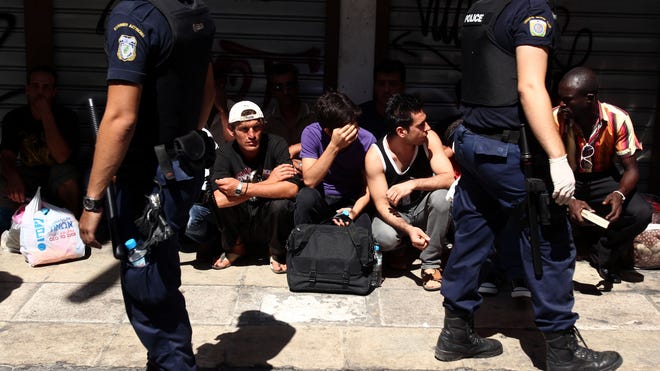
Very depressing news from Greece in the last few days, as the government has rounded up thousands for deportation and shamelessly sought to shift blame for financial issues onto the shoulders of non-citizens.
The minister, Nikos Dendias, defended the mass detentions, saying that a failure to curb a relentless flow of immigrants into Greece would lead the country, which is surviving on foreign loans, to collapse. “Our social fabric is at risk of unraveling,” Mr. Dendias told a private television channel, Skai. “The immigration problem is perhaps even greater than the financial one.”(NYT)
 Oh, if only that were true.

Unfortunately, it is far more likely that this is a cynical move to distract from the country's actual financial problems- reliance on foreign debt, risky lending, artificial inflation- by suggesting that this is an outsider problem, caused by foreigners.

As we have discussed previously in this blog, Greece's asylum system is dangerously backed up, with asylum seekers waiting for years to get a (mandatory) interview or possibly receive refugee status if they are entitled to. With Greece being an entry point into the EU, and with the masses of refugees pouring out of countries effected by the recent tumult in the Middle East, this has meant a compounding of problems- larger numbers of people waiting larger amounts of time to have their status regularized (or, alternatively, to reach a determination that they are not refugees and may legally be deported.) This means some people have been living in Greece for years, waiting to get their status regularized.

It is understandable that the Greek government is anxious to clear up this issue. However, the solution is not to utterly disregard human rights obligations, both under EU and international human rights law, by arbitrarily deporting anyone found during mass "immigration raids" to not possess papers. Not only are some of these individuals likely to be waiting for their appointment with the immigration services, but more to the point, deporting an individual who qualifies as a refugee is refoulement, and is reprehensible and illegal. And you can't tell whether a person is a refugee by a brief glance at their papers, or lack thereof. When 6,000 people are detained over one weekend, it is hard to believe that anyone received a fair shake at a refugee status determination interview.

As history has often demonstrated, in times of economic and social strife it is tempting to rely on xenophobia and anti-immigrant sentiment as a tool of distraction. But that doesn't mean they should get away with it.

Come on, Greece, you can do better.

Previously:
Greece: The Pressure is on to Fix an Failing Asylum System
Deja Vu: Greek Immigration Crackdown


Thursday, April 26, 2012

Freedom of Movement Restrictions: Coming to a European Country Near You

This week has brought some distressing news for fans of freedom of movement. 

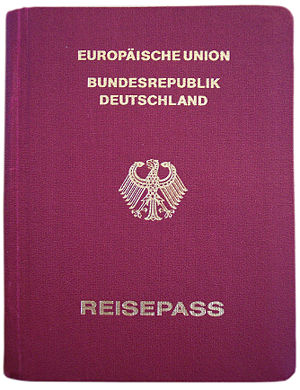
German newspaper Süddeutsche Zeitung has published a report revealing that the German and French Ministers of the Interior are seeking to modify the Schengen Agreemment, the treaty that allows for passport and visa-free travel throughout most of the territory of the EU. According to the letter, they seek to reintroduce border controls for temporary periods of 30 days in order to "curb illegal immigration". This comes on the heels of some German admonishments of Greece in failing to protect its borders (instead opting for creepy immigrant round-ups that violate human rights) AND results of immigration surveys showing that many persons from Southern Europe and elsewhere continue to seek asylum in Western European countries.

Der Spiegel quotes sources speculating that this is all political posturing to appeal to far-right voters in time for the French election. But is it? Following Sarkozy's adventures in deporting Roma from France (which, as you'll recall, drew comparisons to Nazi Germany's deportations of persons on the basis of ethnic background) its not so clear that conservative politicians aren't willing to put their money where their mouth is and disregard Schengen.(Just look at Denmark!)

And while we have Germany and France promising not to let people out, we have Macedonia promising to keep certain kinds of people in. What kind of people, you ask? 
In 2011, the ERRC documented at least 10 cases in which Romani people were denied the right to exit the country at Macedonian border crossings to Bulgaria and Serbia. Border guards regularly stop Romani individuals who they believe may be seeking asylum abroad, denying them the right to leave the countries.
..You guessed it. The European Roma Rights Centre is calling on the Macedonian government to end discrimination against Roma people seeking to travel outside of their country. (Which, if I remember correctly, is a basic human right.) But this baseline discrimination might be just the beginning- the government has announced that it will introduce measures to prevent persons from leaving the country who have once claimed asylum in another state. This measure as well is more than likely to heavily target Roma.

Between Southern Europe cracking down on immigrant and refugee rights and making it harder to move north, and Northern European countries disregarding their own treaties for politically opportunistic reasons, we have a real problem in Europe right now. The question is, what do the citizens of Europe value more? Their freedom of movement, or their freedom from foreigners?

Monday, November 7, 2011

Greece: The pressure is on to fix a failing aslyum system

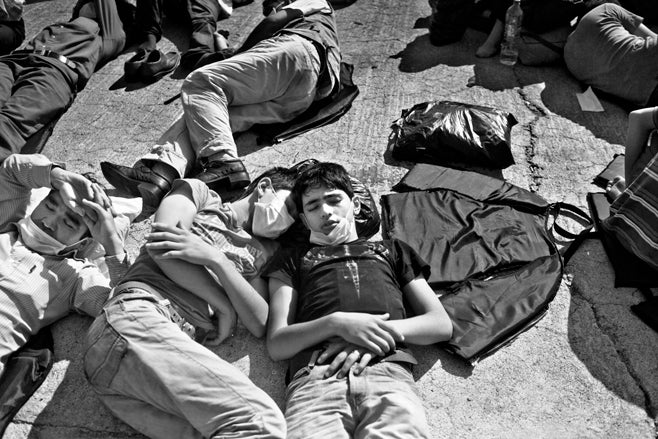
Asylum seekers wait in Greece, photo by Moises Saman
 In addition to the problems Greece's government seems to be having of late with corruption, there are several factors compounding their migration woes. On the one hand, the border between Greece and Turkey is the main entrance point for people fleeing to Europe, making Greece a reluctant EU gatekeeper (alongside a disincentivized Turkey.) On the other hand, you have Dublin II which makes it EU policy to send asylum seekers back to their first entry point in the Union to be processed. In other words, even if plenty of people make it out of the country, Greece can't realistically escape from being a major asylum-seeker center.

The government currently has a giant backlog of asylum applications, a small percentage of which have a chance of being reviewed any time soon if past numbers are anything to go by. As of January 2011 , UNHCR set the number of asylum seekers at over 55,000, and rumor has it that a many people have been waiting more than 10 years to be reviewed. In January the government promised to streamline procedures and set deadlines for decisions, but its not clear that much progress has been made. The events of the last few weeks suggest that the problem is actually getting worse.

On October 26, UNHCR called for a monetary intervention on the border in language that pretty clearly accused the government of wrongdoing (and possibly torture?)
The humanitarian situation on the Greek side of the border is critical, with large numbers of persons detained in extremely difficult conditions, as recently highlighted by the UN's Special Rapporteur on Torture Mr. Manfred Nowak after a visit to the area. Shelter, medical care and psycho-social support are all needed in this situation.
In addition, the press release implied that the current asylum in procedure in Greece is unavailable to most asylum seekers and unable to identify individuals at risk of refoulement.

Quickly coming to the rescue, Norway announced on November 3rd that they would inject 160 million kroner (c.a $28 mil) into Greece's asylum system, to be funneled through the UN. The Memorandum of Understanding, which also involved IOM and other NGOs in Greece, apparently targets the funds for reception centers, in particular for health care for arrivals.

But in the meantime, those asylum-seekers who have been residing in Greece for the last decade face legal limbo, discrimination, and arbitrary procedures. According to a press release this week from the Greek Council for Refugees, there have been recent mass arrests in Athens, leading to abbreviated asylum procedures that violate Greece's own procedural safeguards. It seems that these actions were an attempt to speed up procedures after recieving so much negative attention for their backlog. However, I think the Greek Council for Refugees puts it best:
The attempt of the Ministry of Citizen’s Protection to complete the asylum procedures of as many asylum seekers as possible in the briefest possible time period is obvious. But these actions must not only be aimed at finalizing the procedure but they should be in accordance with the law and protect these people and their rights.

Saturday, March 12, 2011

Denmark: Points and Palestinians


Denmark's ousted Immigration Minister
For the last few weeks Denmark has been rocked by a political scandal featuring leaked documents, intrepid reporting, a shady minister and... stateless Palestinians?

That's right. Denmark, being a signatory to the 1961 Convention on the Reduction of Statelessness, is required to offer citizenship to children born in the country who would otherwise be stateless. On the contrary, it was recently revealed that a number (36, to be exact) of youngsters of Palestinian heritage had been rejected when they applied for citizenship- and that far more had never been informed about their right to become Danish.

Worse, it turns out that this human rights violation was more than just an oversight. The Immigration Minister, Birthe Hornbech, when questioned earlier in the month about her possible involvement, denied any prior knowledge of the mistake and claimed the rejections occurred under earlier administrations.  However, leaks soon made their way out that confirmed that Hornbech knew about the error- as far back as 2008- and failed to inform anyone. She even asked for and recieved legal advice that directly contradicted Denmark's procedure. Now, being forced to file a report at the prompting of a media investigation, Hornbech has been fired as the government tries to distance itself from her actions. But so long as its just an isolated incident, alls well that ends well, right?

Or, one could see this in the context of further worrying anti-immigrant developments that have been occurring in the country in the last year. For instance, in January the government announced a new point system that would make the country's already strict requirements for foreign spouses even tougher. It requires, among other things, that the Danish spouse put up a large sum of money, that both spouses be 24 years old, and that the foreign-born spouse pass a language and knowledge test. In other words, they are trying to make it extremely difficult for Danes to marry foreigners, and possibly violating the ECHR by interfering in the right to private and family life.

These developments are worrying, and are significant of a larger swing to the right throughout Europe. The question is, to what extent can countries' prior generous human rights commitments restrain them from making the temporarily popular decisions that violate them? Denmark would be a good case to watch.

Saturday, February 27, 2010

UK to opt-out of EU Asylum Directive?

According to an article in the Guardian, the United Kingdom is considering opting out of the 2003 asylum procedure directive ("minimum standards directive") . By doing so, they could avoid having to give individual interviews to asylum seekers, and keep their "fast track" asylum procedure in place.
"Ministers fear the EU directive, which forms a key part of developing a common asylum policy, will also block deportations of "manifestly unfounded" failed asylum seekers before they can appeal. About 150 failed asylum seekers a year are told that lodging an appeal against their claim being turned down will not halt their deportation and they can only appeal once they have left Britain."
Not only that, but it would be expensive to implement. (The Home Office lists 37 million pounds, though I'd love to know how they came up with that.)

 We'll have to keep an eye out for further developments on this story... is the UK about to become an even unfriendlier destination for asylum seekers?

Tuesday, February 23, 2010

Iovane on the Universality vs. Relativism of Human Rights

*I will be presenting occasional notes/ reviews of important old and new scholarly articles in migration studies/ law/ political science. When possible I will link to the article*

Article: Massimo Iovane; "The Universality of Human Rights and the International Protection of Cultural Diversity: Some Theoretical and Practical Considerations" (2007)
International Journal on Minority and Group Rights 14.

In this article Iovane explores an apparently unresolvable conflict between two conceptions about morality as it relates to international law.

On the one hand, in order for human rights law to be binding on all sovereign states, it must express to some degree universal conceptions of morality. For example, a prohibition against genocide is considered universally binding because it is agreed upon apart from political or cultural considerations. However, much of human rights law relates to less overarching norms. In fact, they often come from a individualist, western perspective that is hardly uncontroversial. As Iovane states, this conception starts from the position that human dignity is paramount, and moves from there to the belief that individual freedom is the most crucial way to protect human dignity. "Human dignity is thus equated with individual autonomy, and the capacity of independent action is accordingly the only hub and ultimate achievement of human rights."(@232) And this vision is chiefly achieved by states refraining from action that tends to limit individual autonomy. (E.g., not censoring politically sensitive newspapers, not preventing groups from protesting against government policies.)

On the other hand, this vision is not shared by all states. The rise of cultural relativism theory in the 1960's led to the recognition of alternative visions of human rights based on, eg; preservation of tradition, protection of the community interests above those of the individual, and cultural autonomy. This conception may also require a policy of non-intervention: "towards persons with whom we morally disagree, relativist conceptions usually predicate a position of tolerance and non-interference." (@237) But it may also require positive action on behalf of the state such as intervening to protect groups at risk of assimilation.

The problem then arises at how to conciliate these two values. How, for example, do we explain why Female Genital Mutilation (FGM) is a violation of human rights, when it is also a cultural tradition? Further, how do we reconcile a condemnation of a non-western tradition such as FGM but still for allow for widely practiced circumcision of males in the western world? Doesn't this reveal a heavy bias towards western/liberal/ capitalist models?

And continuing with the argument, doesn't the allowance of local, traditional forms of justice and human rights also negate universality? The obvious 'slippery slope' of cultural relativism is a denial of any forms of universal ethical norms, and for individual states and cultures to be able to rationalize any form of abhorrent behavior in the name of cultural relativism. Eek! (Let us, however, also recall here that Western states tend to make exceptions to their support of individual rights when it comes to the overall security of the group, see, for example, the Patriot Act.)

In sum, there are good and bad arguments for both positions, but overall it seems necessary to some degree to find a balance between equality of treatment of individuals and the occasional interference or even discrimination between people to protect minority and group rights.

So, having set up this straw man dichotomy, Iovane strikes it down during the later sections of his article by suggesting that judicial actors, such as the European Court of Human Rights, are best situated to negotiate between these two competing and even mutually exclusive values. As he sees it, several cases addressing linguistic, religious and cultural rights "illustrate the difference between protecting a human right seen from the individual point of view and safeguarding the same right seen as a binding element with a given community"(@256). By being able to make case-by-case decisions, weighing all relevant facts and detaching as much as possible from political considerations, Courts are in a unique position to protect both values while not making overly broad rules that hurt both interests.

I tend to agree with Iovane that Courts are in a better position to make these tough decisions than governments or conventions. However, Courts are also inherently political mechanisms that push the values of the societies they represent, values which may support or crush cultural and political difference. Ultimately, I don't think the very difficult question of how to weigh the rights of the individual with the rights of community is adequately resolved by any Court, but then, what is the alternative institution?

At any rate, this article excellently sums up an interesting dillemma and also has a super bibliography. Can't find a free copy right now, but will post it if I can find one!

Friday, January 29, 2010

News Roundup: Italy- Riots, Racism, and Deportation

[Photo: NY Times]

A tragic clash between African immigrants and Italian youths/ mafioso/ police has set off a debate about Italy's harsh stance on migrants, its reluctance to take on the mafia, and disgraceful racism that is exploited by this government's actions.

BBC was there on Jan. 8th: African Migrants Riot Over 'Racist' Attack in Italy
Several people have been injured in rioting that broke out in southern Italy after an attack on immigrant farm workers by local youths. The migrants, mainly Africans, clashed with police after taking to the streets of the Calabrian town of Rosarno.

More in depth coverage from the NY Times: Race Riots Grip Italian Town, and Mafia is Suspected
More than a thousand African workers were put aboard buses and trains in the southern Italian region of Calabria over the weekend and shipped out to immigrant detention centers, following some of the country’s worst riots in years.

The Economist weighs in: Southern Misery
In a few days, it will seem as if they were never there. On January 11th bulldozers in the southern Italian town of Rosarno began obliterating the wretched dwellings from which more than 1,000 African crop-pickers had fled or been evacuated by police over the weekend. Left behind were seven of their fellows, recovering in local hospitals from gunshot wounds and savage beatings inflicted by Italians. It was an ethnic clearance of Balkan swiftness, nastiness and comprehensiveness that shocked many Italians and prompted them to question their society’s attitudes to race and colour. Only a handful of black or Arab immigrants remained in Rosarno. And within 24 hours, one had his car torched.

Great Editorial from the NY Times: http://www.nytimes.com/2010/01/25/opinion/25saviano.html

There are native Italians who reject mafia rule as well, but they have the means and the freedom to leave places like Rosarno, becoming migrants themselves. The Africans can’t. They have to stand up to the clans. They know they have to act collectively, for it’s their only way of protecting themselves. Otherwise they end up getting killed, which happens sometimes even to the European immigrant workers.

It’s a mistake to view the Rosarno rioters as criminals. The Rosarno riots were not about attacking the law, but about gaining access to the law.

Sunday, November 15, 2009

So... what's going on in Greece and Turkey?

[Photo: Andrea Motta]
New on Greece and Turkey

Six Die in Migrant Boat Accident
Eight Afghan Illegal Immigrants Drown off Coast of Greek Island
Two recent incidents highlight the dangers that some immigrants are willing to face in order to gain access to the European Union, and the importance of heightened communication and cooperation with Turkey in dealing the EU border states. In both cases, a boat full of illegal immigrants, once with passengers from Palestine, and the other from Afghanistan, capsized in the Aegean Sea resulting in the deaths of the passengers. Both boats were carrying children.

Greece Shuts down Migrant Detention Center
Even those lucky enough to make it into Greece face grave difficulties, as this article demonstrates. A detention center on the Isle of Lesbos that had come under fire for its human rights abuses by the UNHCR was closed by Greek authorities, and its 900 inhabitants were sent to neighboring islands. The center will reopen and expect to hold roughly 150 immigrants.

Turkey Frets over EU's Illegal Immigrants
As illegal immigration increases, Greece and Turkey have become primary barriers into the EU, and the way these two countries handle illegal immigrants have huge significance: both for the EU's human rights reputation and for the potential for Turkish accession. The prime Turkish negotiator for accession, Egemen Bağış, highlighted this issue recently, claiming that it demonstrates why Turkey can be considered both a "bridge" and a "barrier" to the Middle East.

Lastly, a report by NGO's the Norwegian Helsinki Committee, NOAS and AITIMA chastises Greece for massive deportations of immigrations without assessment of their claims to refugee status, in violation of the 1951 Geneva Convention.

Clearly, as borders of Europe, Turkey and Greece shoulder a disproportionate amount of responsibility for how the European Union welcomes and treats its immigrants. However, it is crucial that Europe shows its commitment to refugee and human rights conventions by insisting that these nations respect the human rights of those so desperate for access to Europe.