Pages

Showing posts with label USA. Show all posts

Monday, October 15, 2012

New Report: Unnacompanied Minors on the Rise in Central America

The Women's Refugee Commission has released a new report on unaccompanied minors entitled,
"Forced from Home: The Lost Boys and Girls of Central America". According to the report, the number of child migrants apprehended traveling to the US from Guatemala, Honduras, and El Salvador has almost doubled .

The research conducted by the WRC confirms that the continuing problem of gang violence, coupled with heavy-handed tactics of police that tend to consider all youngsters potential gang members, has led to the upswing and created a "lost generation." In addition, girls are at a particular disadvantage since they are vulnerable to both gang violence and gender-based violence. Although there is also poverty in these countries, the majority of children seem to be fleeing from violence.
The conditions in Central America have deteriorated to such a point that, when the WRC asked the children if they would risk the dangerous journey north through Mexico all over again now that they had direct knowledge of its risks, most replied that they would. They said that staying in their country would guarantee death, and that making the dangerous journey would at least give them a chance to survive. Many of them expressed a longing for their homelands, stating that they would not have left but for fear for their lives (at 7).
Since the conditions in these countries don't seem to the changing (and let's recall that the US has contributed to the Central American gang problem significantly) it makes sense for the Government to adjust certain measures to ensure the human rights of these children are protected.

The report outlines a number of ways for the government to improve its response, but I would like to emphasize one in particular: unnacompanied minors are not entitled to legal assistance or lawyers, and often have to defend themselves from deportation in court. This is just patently unfair and should be the first thing to change. When a child's life is in the balance, he or she should have a better shot than an elementary grasp of a foreign legal system and 15 minutes in front of an impatient judge.

The entire report is worth a read, and is available for download here.

Read More:
 Gangs without Borders (SFGate)
National Center for Refugee and Immigrant Children
Gang-Based Asylum Claims (Immigrant Law Center of Minnesota)

Wednesday, August 1, 2012

Go Guor! Stateless Marathoner to Compete in Olympics

The Olympics is typically a time when even the most timid of citizens become flag-wavers for their country, counting the medals their home country racks up and paying close attention when their country faces off against historical or modern rivals. But one Olympian is drawing media attention not because of his nationality but because of a lack thereof- stateless marathoner Guor Marial.

Marial was born in South Sudan, where he was one of countless children kidnapped and forced into labor during the Sudanese Civil War. As a refugee in Egypt, and later the United States, he left behind many deceased family members and has not seen his parents in 20 years (the complete story can be found here). Marial wouldn't be the first refugee of the Sudan conflict to compete in the Olympics. However, unlike Lopez Lemong, a Sudanese refugee who was a flag-bearer in the Beijing Olympics, Marial does not possess US Citizenship, and will be competing under the Olympic Flag. Despite being offered to compete for Sudan, Marial declined, “It’s not right for me to do that.  It’s not right for me to represent the country I refuged from.”

Media reports have been presenting the case as an uplifting, if bewildering, human interest story. Time noted that if he wins, Marial will stand on the podium while the Olympic hymn (rather than a national anthem) is played. Die Welt ran their article on him with the headline "No Flag and No Hymn." These Olympic trappings are so common that their lack is as headline-making as the shocking story that put him in this situation.

Other articles refer to him simply as a refugee, portraying him as an unoffficial Sudanese representative despite his strong declarations to the contrary.

With an estimated 12 million stateless and 43 million refugees worldwide, belonging to either group is not so remarkable in and of itself. More remarkable to me is the ability of the Olympics, a bastion of nationalism, to allow for some ambiguity in their ceremonial trappings in a way that represents the true nature of a world that is composed of citizens, stateless people, and everything in between. Its obvious that rather than being a disadvantage, being stateless will only cause Mr. Marial to receive even more support when he competes on August 12th.

Tuesday, May 1, 2012

Excerpts from Arizona V. US

Last week the Supreme Court heard arguments in the case Arizona, et. al, v US concerning the god-awful Arizona immigration law SB 1070. You can now read the whole transcript online, but in case you're not in the mood to read the whole, depressing thing, I thought I would provide some salient excerpts below.

The first issue that the justices really pounced on was the section of the law pertaining to holding a person for suspected immigration violation. The justices were concerned that the time taken to check on the suspect's immigration status could result in them being imprisoned for unreasonable stretches of time, and Paul Clement, atty for Arizona, emphasized that length of imprisonment would still be governed under the 4th amendment.
"JUSTICE GINSBURG: But how would the State officer know if the person is removable? I mean, that's sometimes a complex inquiry.
MR. CLEMENT: Well, Justice Ginsburg, I think there's two answers to that. One is, you're right, sometimes it's a complex inquiry, sometimes it's a straightforward inquiry. It could be murder, it could be a drug crime. But I think the practical answer to the question is by hypothesis, there's going to be inquiry made to the Federal immigration authorities, either the Law Enforcement Support Center or a 287(g) officer.
And presumably, as a part of that inquiry, they can figure out whether or not this is a removable offense, or at least a substantially likely removable offense.
JUSTICE KENNEDY: Suppose it takes 2 weeks to make that determination, can the alien be held by the State for that whole period of time -MR.
CLEMENT: Oh, I don't think -
JUSTICE KENNEDY: -- just under section 6?
MR. CLEMENT:I don't think so, Your Honor, and I think that, you know, what -- in all of these provisions, you have the Fourth Amendment backing up the limits..."
Next, Clement had a chance to make his argument on federal preemption. Whenever states get into areas of governance that usually dominated by the federal government, there is the potential for a claim that the federal law "pre-empts" and overrules the state level law. Let's see Clement's argument.
"I do think as to section 3, the question is really -- it's a provision that is parallel to the Federal requirements, and imposes the same punishments as the Federal requirement.
So it's generally not a fertile ground for preemption. But of course, there are cases that find preemption even in those analogous circumstances. They're the cases that the government is forced to rely on."
He then goes on to differentiate the AZ law from the ones in other federal preemption cases that the government is likely to bring up. However, the gist of the argument is always that the law is duplicated, so its hard to say that it conflicts with the federal requirements.
"And so I think the right analysis is really the analysis that this Court laid out in its Whiting decision, which says that in these kinds of cases, what you look for is whether or not the State scheme directly interferes with the operation of the Federal scheme."
Next up to bat we had the atty for the government, our hero Donald Verrilli. Verrilli comes out immediately with the main federal preemption argument:
"GENERAL VERRILLI: Mr. Clement is working hard this morning to portray S.B. 1070 as an aid to Federal immigration enforcement. But the very first provision of the statute declares that Arizona is pursuing its own policy of attrition through enforcement, and that the provisions of this law are designed to work together to drive unlawfully present aliens out of the State.
That is something Arizona cannot do, because the Constitution vests exclusive -JUSTICE
SOTOMAYOR: General, could you answer Justice Scalia's earlier question to your adversary? He asked whether it would be the Government's position that Arizona doesn't have the power to exclude or remove -- to exclude from its borders a person who's here illegally.
GENERAL VERRILLI: That is our position, Your Honor. It is our position because the Constitution vests exclusive authority over immigration matters with the national government."
After the assist from Sotomayor, Verrilli spends the rest of the time getting picked apart by Roberts and Scalia.
CHIEF JUSTICE ROBERTS: You think there are individual cases in which the State can call the Federal Government and say: Is this person here illegally?
GENERAL VERRILLI: Yes, certainly. But that doesn't make -CHIEF
JUSTICE ROBERTS: Okay. So doesn't that defeat the facial challenge to the Act?
Problematically for the government, they didn't rely on the possibility of racial profiling as a reason to challenge the law, although that was the constant "elephant in the room" of the argument.
GENERAL VERRILLI: ... Now, we are not making an allegation of racial profiling. Nevertheless, there are already tens of thousands of stops that result in inquiries in Arizona, even in the absence of S.B. 1070. It stands to reason that the legislature thought that that wasn't sufficient and there needed to be more.
And given that you have a population in Arizona of 2 million Latinos, of whom only 400,000 at most are there unlawfully -
JUSTICE SCALIA: Sounds like racial profiling to me.
From here, it gets really messy. After failing to sell the preemption claim (Scalia and Roberts interpreted the Arizona statute as "helping" the federal government) Verrilli focused on the foreign relations aspect.
VERRILLI: What they're going to do is engage, effectively, in mass incarceration, because the obligation ...[is]...to enforce Federal immigration law, which is what they claim they are doing .... And so -- so you're going to have a situation of mass incarceration of people who are unlawfully present. That ... poses a very serious risk of raising significant foreign relations problems.And these problems are real. That is the problem of reciprocal treatment of United States citizens in other countries.
JUSTICE KENNEDY: So you're saying the government has a legitimate interest in not enforcing its laws?
GENERAL VERRILLI: No.
UGH. As we can see, this did not turn out well. The real problem at stake in SB 1070 is that police can just pull over any Latino, incarcerate them for a while and ask the government to figure out their immigration status. Problematically, due to VAWA, TPS, and asylum, this isn't always the straightforward question that one might think. So, because of our complex immigration laws in combination with this terrible statute, the result is a situation that allows for the incarceration and punishment of a section of the population to the extent that, even if they are legally here, they won't want to live in Arizona any more. And that is the point of the law. "Attrition through enforcement."


Harassing and annoying every Latino citizen of Arizona is racist, inhumane, and embarrassing for the US. But is it unconstitutional? Its going to take some fancy footwork to make that claim from the arguments in this case.

Tuesday, April 3, 2012

Non-Citizen News Roundup

Greece police roundup immigrants this week, via LA Times
There's a lot going on in world of non-citizens this week!

Greece: Last week I noted the alarming news out of Athens, where police arrested some 500 people during an "immigration sweep" in the Capitol that they announced would be continued regularly. Amnesty International has added their voice to the growing concern about the practice, noting:
There are no appropriate facilities at Greece's borders for the identification of those in need of international protection, such as victims of torture and unaccompanied or separated asylum-seeking children.
Detaining people arbitrarily in massive "sweeps" without the necessary protective measures for persons entitled to different forms of protection violates Greece's international obligations and contributes to stigmatization of a group that is already at risk in the country. I said it before and I'll see it again: Greece would be far better off using the resources needed for such massive police actions on clearing through their backlog of immigration cases and regularizing the status of those who are entitled to it.

USA: Despite the Obama administration's ambitious new immigration guidelines for LGBTI persons, they aren't out of the water on gay immigration issues yet. A class action suit filed Monday by 5 same-sex couples will challenge DOMA (the Defense of Marriage Act) - a 1996 law that bars the federal government from recognizing same-sex marriages. Since immigration and citizenship are the realm of the federal government, the impact is that even couples who marry legally (e.g., in NY) cannot access immigration benefits such as a green card for the foreign partner. Obviously this causes many heart-rending situations where a married couple may have to constantly fear that one spouse will be deported.

The case is being brought by a non-profit called Immigration Equality, and I will definitely be following it closely here as it proceeds through the legal system. This could be a landmark case for immigration equality in the United States and since the Obama administration has already announced that they consider DOMA to be unconstitutional it could be a slam dunk. I'm excited about this one, guys!
Immigration Equality: Taking our Case to Court

Ghana/ Liberia: There's been talk for years (at least since 2008) of Ghana activating the cessation clause and closing down refugee camps housing Liberians who fled during years of civil war. (Recall that they cessation clause of the 1951 Convention comes into effect when the situation that produced the potential for refoulement to the home country ceases to exist.) Annnnd now the talk continues, with the Ghanaian government planning to activate the cessation clause June 30th but hoping that most refugees will opt for voluntary repatriation before then. For many of the refugees who have lived in the country for years, returning to Liberia is simply not an option, and they will seek options to regularize their status before being kicked out. I'll be sure to post developments. 
Relief Net: Days numbered for Liberian Refugees

Friday, March 23, 2012

The Way to be in a PSG: Obama's new Guidelines on LGBTI Asylum

As promised, I wanted to highlight some of the guidelines offered by USCIS in their new training module on handling asylum claims of Lesbian, Gay, Bisexual, Transgendered, and Intersex persons. I've discussed LBQT (but not Intersex) asylum claims on this blog before, and one of the big themes encountered was the phenom of being"not gay enough for the USA"- individuals being turned down for asylum claims because their outward behavior did not match preconceived notions of what gay people act like. (For example, a lesbian with a child from a previous marriage, a man not "out" to his friends or family.) Let's check out how the new training addresses these and other important issues.

Defining LGBTI
Towards the beginning of the guidelines there is a set of definitions which does an excellent job of dispelling certain myths and the LGBTI community. For example, the section differentiates between sexual orientation, sex, and gender identity, and defines intersex and transgender deftly as well, being sure to not lump all categories into one.
 "Transgender is a gender identity, not a sexual orientation. Thus, like any other man or woman, a transgender person may have a heterosexual, bisexual or homosexual sexual orientation." (at 13)
Additionally, the module lumps in HIV and AIDs issues- both because persons with AIDs are sometimes persecuted for being gay (even when they are not) and persons who are gay are sometimes persecuted for having AIDs (even when they do not.) 

Havana Social Club- Does being gay put you in a "particular social group?"
As you may recall, to qualify as a refugee under the 1951 convention you must demonstrate a well-founded fear of persecution in your home country on the basis of your race, national origin, religion, membership in a particular social group, or political opinion. LGBTI asylum claims have long been handled under the "membership in a particular social group" (PSG) portion of 1951, and the case that is most relied on is Matter of Acosta. (I previously reviewed Acosta here.)

The guidelines make a point of adding to Acosta a newer precedent relevant in making immigration decisions for the LGBTI crowd: Matter of Toboso Alfonso (1990), a case involving a Cuban national claiming persecution for being gay. In Cuba, the government would force him to appear for forced exams where he was probed about his sex life, detain him on occasion, and tolerate harassment and violence against him and other gays, culminating in being chased out of Cuba by what amounted to an angry mob. In the case, TA had been convicted of several crimes making him ineligible for asylum, but the judge granted "leave from deportation" (which has similar criteria) on the basis of his past persecution in Cuba, where he was overtly targeted as a homosexual. The INS appealed, stating (rather heartlessly, even for back then),"socially deviant behavior, ie, homosexual activity is not a basis for finding a social group within the contemplation of the act." They went on to explain that such a decision would pave the way for people to be awarded protection for deviant, even illegal behavior in their home country. Are we going to start granting asylum to people that broke their country's law and don't want to go to jail?

The BIA disagreed, finding that TA was targeted not so much due to his illegal or deviant behavior, but because of his status as a homosexual, an "immutable characteristic" that he could not, and should not be required to change. Thus we have it: a game-changing BIA decision filing "gay" as a potential particular social group under the refugee convention as well as the US's own laws.

Now, this was a specific case with a man whose story left very little room for doubt that he was being persecuted on the basis of his "status" as a gay man. However, the guidelines now set out to make it crystal clear that this decision was not just about gay male Cubans. PSGs might be also be comprised of transgendered persons (gay or straight), "closeted" gays and lesbians, HIV+ persons, persons viewed by society as not fitting gender roles (eg, being an effeminate male) AND (in case you aren't getting it) people who are NOT EVEN from Cuba. (at 15.) The point is, the kind of neanderthals that want to beat up sexual minorities are not going to care if you're not actually a sexual minority. And that doesn't mean you shouldn't get protection.

So it covers people that might look or act gay (through the persecutor's eyes) but aren't. But it also effectively states that you don't have to "look or act gay"to fit into the precedents of TA or Matter of Acosta.
When analyzing the PSG issue, you must not only make a finding regarding immutability or fundamentality, you must also determine social visibility or social distinction, i.e., whether the actual or imputed characteristic is "easily recognizable and understood by others to constitute a social group." Some adjudicators mistakenly believe that social visibility or distinction requires that the applicant “look gay or act gay.”  In this context, social visibility or distinction does not mean visible to the eye. Rather, this means that the society in question distinguishes individuals who share this trait from individuals who do not. (at 16.)
 In other words, the Obama administration is promulgating as US law an important, and possibly life-saving principle: when it comes to the LGBTI community, one's membership in a PSG is all in the eyes of the persecutor.

Wednesday, March 14, 2012

Non-Citizen News Round-Up


Refugee Camp in Boynuyogan, Turkey in June (via MSNBC

Italy: The European Court of Human Rights issues a major smackdown to Italy this week, ruling in Hirsi Jamaa and Others v. Italy that the policy of intercepting migrant boats at sea and returning them (most often to Libya) breached their various obligations of non-refoulement. (Not exactly tough to see why.) This case is HUGE because its one of the rare instances the Court has ruled on the prohibition against mass-expulsion, as well as adding to already strong migrants and refugee rights jurisprudence at the court. Check it out!
Case of Hirsi Jamaa and Others v. Italy (ECtHR) 
Yet Another Mala Figura: Italy Breached Non-Refoulement Obligations (EJIL Blog)

USA: In news welcomed by LGBQT Refugee advocates, the Obama administration has published clarified rules for courts and asylum officers on adjudicating asylum claims based on membership in one of these persecuted social group. I will probably do a full post on this later but for now there is every reason to be pleased at this news, particularly since the glance I've taken shows the gov moving away from the "married/pregnant/ straight-looking people can't be persecuted as gay" techniques that characterized past cases in the US.
Guidance for Adjudicating Lesbian, Gay, Bisexual, Transgender and Intersex Refugee and Asylum Claims (USCIS) (pdf)
LBQT Asylum in US Made a Little Easier (Care 2)


Turkey: Of course, more than any other story this week, focus should be on the Syrians streaming into Turkey fleeing increasing violence. There are now reports that landmines have been laid across escape routes to prevent would-be refugees from escaping. Meanwhile, in response to the emergency UNHCR has appointed a special coordinator for the region's refugees and internally displaced.
On the Turkish Border, a Stream of Fleeing Syrians (Reuters)
Syria: Army Planting Banned Landmines (Human Rights Watch)
UNHCR appioints regional refugee coordinator for Syrian Refugees (UNHCR)

Friday, January 27, 2012

Non-Citizen News Roundup


U.S. Atty Fein at a press conference announcing the indictment, via AP
US: Federal charges have been brought against members of the police force in East Haven, Connecticut for charges ranging from excessive force and false arrest to conspiracy. The basis for the charges is years of harassment and violence against the immigrant community.
"They stopped and detained people, particularly immigrants, without reason, federal prosecutors said, sometimes slapping, hitting or kicking them when they were handcuffed, and once smashing a man’s head into a wall. They followed and arrested residents, including a local priest, who tried to document their behavior."
So despicable, but sadly common in other small towns in America, where picking on immigrants is a pastime as well as a source of income. (As many immigrants, lacking bank account, carry large sums of cash on their person.) Let's hope this action by the Justice Dept. sends a message to police officers like those in East Haven that their racial profiling and bullying will no longer be tolerated. 
NY Times: Police Gang Tyrannized Latinos, Indictment Says
CT.com: Feds Indict 4 East Haven cops in racial profiling abuse case, more may be on the way

Kuwait: 61 of the bidoon/ stateless protestors (that we discussed last week) are being imprisoned for an additional 3 weeks pending further investigations into the protests. The charges include assaulting police and instigating an illegal gathering, although the news out of Kuwait suggests if anyone turned the protests violent, it was police.
AFP: Kuwait detains Stateless Protestors for 3 Weeks

Australia: More than 50 persons in Australian detention are recognized as refugees but unable to leave due to having failed security tests. The security tests have expanded their definitions of threats in the last years, and having being classified as a threat most countries are unwilling to receive the individuals (understandably.) The refugees are not informed why they failed, nor are they accepted by their home country, leaving them in legal limbo without much hope of a resolution. As the Australian human rights violations stack up, you really have to wonder what their government is thinking.
ABC Sydney: Darwin refugees in limbo after failing ASIO tests

Thursday, December 8, 2011

Landmark Stateless Conference in Geneva this Week

As mentioned a few weeks ago, the UNHCR is holding its major conference on forced displacement and statelessness this week in Geneva. Today is the second day of the conference, and of course we are all eagerly waiting to hear what is in store (and especially whether any states will be making announcements pertaining to Treaty signatures). However, a lot has already happened, so here is a quick recap for those of us not lucky enough to be in Geneva.
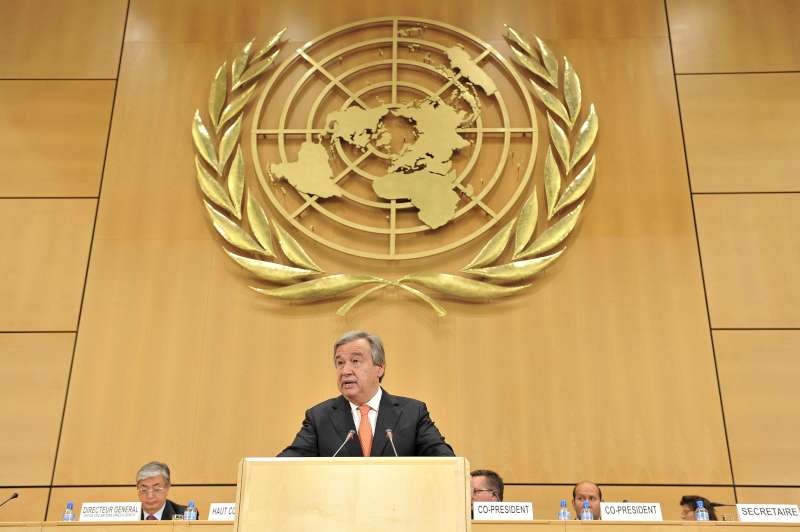
  •  High Commish Antonio Guterres opened the event with a speech emphasizing re-commitment, especially in the face of increased fear and intolerance. "Populist politicians and irresponsible elements of the media exploit feelings of fear and insecurity to scapegoat foreigners, to try to force the adoption of restrictive policies, and to actively spread racist and xenophobic sentiments," he said, in a comment that was a little more political than one is used to hearing from UNHCR. He emphasized the principles of collective security and non-refoulement that underlie the refugee regime, and announced a new effort by the organization to concentrate more heavily on gender and sex-based violence.
  • A theme of the conference was "pledges for refugees:" States were encouraged to make commitments to strengthen existing laws or create new ones designed to identity and protect stateless persons and refugees. Most of the attendees apparently pledged to help in one way or another. (See some on twitter, #pledges4refugees")
  • Sarnata Reynolds was live-tweeting the events yesterday and her tweets are definitely worth a perusal. Among the revelations: Georgia is about to pass the 1951 Statelessness Convention (YES!), Korea will adopt legislation promoting rights of asylum-seekers, Papa New Guinea will lift reservations on conventions (among other things), and Krygistan will promote child registration to reduce statelessness. If even some of the pledges are kept, the conference will have been a huge success!
  • Serbia mysteriously alluded to new changes to the citizenship laws that would "enable all persons in Serbia’s territory to acquire citizenship". I'm working on this issue right now, so I am very curious to what they are referring... Remarks available here.
  • U.S. Secretary of State Hillary Clinton gave a speech focusing on gender and statelessness, highlighting the link between discriminatory citizenship laws and children born stateless. "Because of these discriminatory laws, women often can’t register their marriages, the births of their children, or deaths in their families. So these laws perpetuate generations of stateless people, who are often unable to work legally or travel freely..."  She then went on to pledge the US's support in encouraging universal birth registration. Oh man, if loving Hillary Clinton is wrong, I don't want to be right. (Full text of speech available here.)
The conference continues today! You can follow it live via satelite here at the UNHCR's livestream.

Thursday, November 17, 2011

Is it a good thing? Sweeping changes to US ICE

The NY Times is reporting  that they have obtained a document describing the new immigration priorities policy that Homeland Security will kick off this week- and it is a big deal, effecting some 300,000 cases. Let's break it down.

The policy will be aimed at instructing all actors in the deportation process- from immigration agents, to judges, to prosecutors- to streamline their cases to fit the following priorities: close out cases of non-dangerous undocumented immigrants, and speed up deportations of criminals. According to the Times, the policy is intended to:
scale back deportations of illegal immigrants who were young students, military service members, elderly people or close family of American citizens, among others.
For immigration agents, this means releasing (or perhaps not catching in the first place) people that are not dangerous criminals, repeat offenders, or national security risks. For prosecutors, this means exercising discretion in which cases to bring before the judges. And for judges, this means a more lenient approach to immigration law violators. Sounds like a good deal, right? Particularly in comparison to the heavy-handed approach the Obama administration has taken in ordering over 400,000 deportations (the most of any President in recent memory) in each of the first three years of his presidency. Perhaps that was an effort to clear out the courts to make way for this more liberal policy?

However, there is still much to be concerned about. I visited an immigration detention facility not  long ago, where most individuals held were repeat offenders or criminals. However, the most frequent crime was "loitering," that is, dwelling outside of a hardware store or similar, waiting for work. Will the new policy consider people like this to be deportable?

In addition, while Homeland Security pushes a discretionary, flexible approach, the states are in some cases pushing the opposite message. Alabama, Georgia, Arizona and other states have laws on the books making police officers responsible to some degree for enforcing immigration laws- will they also get the memo that passing non-violent undocumented youth into federal hands is likely to lead to an eventual release? And which level- state or federal- is more likely to have the more immediate impact on immigrant's lives?

At the end of the day, the mish-mash of approaches taken by the US government in the last few decades leads to fear and confusion among immigrants primarily, but also to ample confusion among the law enforcement professionals meant to interpret these laws and policies on every level. It is encouraging to see the Obama administration taking the heat off non-criminal and youth immigration law violators, but until we see Comprehensive Immigration Reform it seems hard to believe that everyone that needs to know will get the message.

US to Review Cases Seeking Deportation (via NY Times)

Thursday, October 27, 2011

Two New Lawsuits Shed Light on Immigrant Injustice in the States


On the same day last week two major non-profit organizations filed suit in the US over fairly shocking circumstances relating to immigrants and refugees. If they win, we could see some excellent new case law on immigrant rights. Here's a quick run-down.

Florida Tuition Inequality
In Ruiz v. Robinson (complaint) the Southern Poverty Law Center is suing the Florida Board of Education for a policy that, according to the suit, "treat[s] United States citizen students who reside in Florida as “non-residents” solely because their parents are undocumented immigrants." The effect of this policy is to hike tuition prices up to out-of-state rates (i.e., triple the cost for residents), and moreover, to discourage children of undocumented immigrants from attending college. Here's an example of the effect of the policy, as seen through plaintiff Caroline Roa:
...After Caroline was accepted to Miami Dade College, school officials informed her that she did not qualify for in-state tuition, even though she had resided in Miami-Dade County since birth. School officials explained to Caroline that her residency for tuition purposes was based on her father’s legal residence. Because Caroline could not show proof of her father’s legal immigration presence in the United States, she could not qualify for in-state tuition rates. Unable to afford non-resident tuition rates, Caroline has not enrolled in college. Instead, she works two jobs in the hope of one day being able to afford college.
Interestingly, the class action suit takes a dual legal track- SPLC challenges the policy under the 14th amendment's equal protection clause, but they also bring a federal preemption claim under the Supremacy Clause. In other words, they argue Florida's attempts to deny residency to the children of undocumented immigrants represents an impermissible attempt to regulate immigration- a field squarely within the exclusive domain of the federal government.

In my opinion, the equal protection argument is a slam dunk- these children are clearly being treated differently then other similarly situated children on the basis of their parent's immigration status... its going to be difficult for Florida to come up with a compelling justification for that which makes logical sense. The federal preemption argument, on the other hand, is a touchy subject. It has been a bumpy road for cases using this claim before, and now more than ever, with so many pending challenges to state statutes regulating immigration in some way, it will be interesting to see how the argument fares. One could suspect this case makes the point clearly, that when states try to regulate immigration they end up doing things that hurt citizens as well as non-citizens.

Sex Abuse in Immigration Detention
The second case is being brought by the ACLU against a Texas corrections facility, workers there, and the ICE for allegations of sexual assault against immigrants detained there. (Oy.) Essentially, the ACLU found hundreds of such allegations after filing a Freedom of Information Act request with ICE and Homeland Security. Although such allegations were found in every state, Texas had by far the most, and is thus the focus of the suit. An example of one of the stories can be found here. (Warning: graphic.)

Even more tragically, the plaintiffs named in the suit were asylum seekers escaping sexual violence in their home countries. It is ridiculous that people have to face this additional hardship in detention centers and it is obviously a violation of their human rights and basic tort law. I think this case will have no problem succeeding, but it remains to be seen how to protect the thousands of immigrants in custody all over the US from such horror. One way may be a legislative angle- extending the Prison Rape Elimination Act to immigrant detainees. The Act, passed by President Bush in 2003, establishes a national commission to prevent prison rape, assists with data sharing, and makes prevention a major priority for each prison system-- except for in immigration detention.

Here is a petition from the ACLU to President Obama asking them, as a first step, to extend the Prison Rape Elimination Act to all prisoners in the US: "President Obama: Protect Women Held in US Custody from Rampant Sexual Abuse"

****
What these two cases have in common is that they focus on rather non-contentious ways of preventing discrimination against immigrants. After all, the first case actually focuses on US citizens (though it arguably helps their undocumented parents), and the second reiterates a minimum standard for detention that should not even really be at issue, bodily integrity. There are much deeper problems facing the  American immigration system at the moment, but these two cases will hopefully be big wins that pave the way for more aggressive strategies in the fight to protect undocumented immigrants.

Tuesday, October 18, 2011

UNHCR Report: Trends for the first half of 2011

Serbian asylum seekers, via Serbian Herald
Today UNHCR released a report detailing asylum trends in 44 countries for the first half of 2011. It by no means offers a complete picture, given that it basically covers the Council of Europe plus a handful of other industrialized countries, but it is still packed with interesting findings. Among them:
  • Asylum applications are up overall by 17%, with the large majority (73%) being filed in Europe, but the USA accounting for the one single country receiving the most applications.
  • Asylum trends are not consistent over Europe, with applications down by 27% in the Nordic region (Danish immigration crackdown, anyone?) and asylum claims jumping by 57% in Southern Europe, especially in Turkey, Malta and Italy.
  • Afghanistan leads asylum seeker sending states, followed by China, Serbia (incl. Kosovo), Iraq and Iran.
  • The next 5 biggest sending states are Russia, Pakistan, Somalia, Eritrea and Nigeria
  • The top 5 receiving countries; USA, France, Germany, Sweden and the UK, received 53% of all the applications.
There are plenty of interesting findings within the report, but to me there are two big take-aways. First, "Arab Spring" didn't have the tremendous overall impact that one would expect- none of those countries involved made it into the top 10 asylum-seeker sending states, at least not for industrialized countries. On the other hand, Southern Europe's big jump in applications are partially attributable to Tunisia and Libya, which adds verification to the region's reputation as Europe's gatekeeper, and perhaps explains the upswing in anti-migrant violence we saw in Italy earlier this year.

The second interesting fact is Serbia's continued presence in the top 5 asylum-sending countries. Keeping in mind that Serbia has just been given the go-ahead for EU Applicant status, possibly to be agreed upon as soon as December, one can only hope that this will increase scrutiny of Serbia's human rights situation. Especially when it comes to the Roma, whom for my money probably make up the majority of asylum seekers.

You can read the whole report here:  Asylum Levels and Trends in Industrialized Countries

Monday, October 17, 2011

Non-Citizen News Roundup

Map showing border enclaves, via The Economist
 India/ Bangladesh: People living on the border region's "enclaves" have been stateless and living in destitute poverty for nearly 60 years, but have seen their living conditions deteriorate even further as river waters rise and engulf their villages. Now, villagers from both sides are protesting to ask the government to implement a border enclaves exchange that will swap territories and make it possible for people to gain citizenship and access to basic public services.
People Stateless at India-Bangladesh border (with video) (via IBN)
Border Agreements- The End of the Enclaves  (via The Economist)

 Australia: Everyone is still miffed about the abandoned Malaysian Refugee Swap solution. The public is angry about the alleged $4.6 million in preaparatory costs for the plan. Tbe Prime Minister isn't thrilled about leaks about the plan from the cabinet making its way to the media. And would-be refugees are probably pissed that the shelving of the deal also means an additional 1000 yearly spots for refugees in Australia are off the table. In sum, what a disaster.
 Government defends cost of Malaysia Solution (via ABC Sydney)
 PM Guillard warns against cabinet leaks (via Sydney Morning Herald)

California: Governor Jerry Brown signs in a new package of laws aimed at helping undocumented migrants. Most importantly, he signed a state-version of the DREAM Act that makes it possible for undocumented students to apply for student aid. As the NY Times puts it,  "With these new laws, California is telling immigrants not to stay hidden but to get educated and keep working hard." What a contrast to the message being sent in Alabama.
Brown Signs California Dream Act (via LA Times)
A Sensible Path in California (via NY Times)


Wednesday, October 12, 2011

Alabama Latinos protest "Juan Crow" Immigration Law

Scenes from an protest in June, photo by Mark Almond/ The Birmingham News
Good news out of Alabama today, as Latinos across the state stay home from work as a show of solidarity against the dreadful, recently upheld immigration law (HB-56). The law, which is likely the most punitive in the country, requires a number of harsh measures aimed at making the state as uncomfortable as possible for undocumented migrants. As its written the law has provisions that make it a crime to transport undocumented immigrants (because you can tell, just by looking at them) and makes it illegal for colleges to enroll undcocumented students (because, once again, university admission counselors are perfectly equipped to make immigration status determinations.)  Most importantly, the law requires police to verify immigration status during many routine encounters, such as traffic stops. Not only that, but in a move that brazenly violates federal jurisprudence, the law requires schools to verify immigration status while enrolling children. The effect of these measures is to encourage police harassment of Latinos, to cause children to stay home from school, and to reduce an entire segment of the population to living in fear and uncertainty.

That's why its very encouraging to see Latinos across the state- both documented and undocumented- staying home from work to peacefully protest.
"We want the mayor, the governor, this judge to know we are part of the economy of Alabama," said Mexican immigrant Mireya Bonilla.
Its important to note here that even US citizens are participating in this protest, according to reports. Given the nature of immigration status, it is more than clear that a law that provides for measures against people "suspected of being illegal" is code-wording for  Latino. State governments need to know that when they pass laws that broadly encourage racial profiling and discrimination against Latinos, that the legally-present won't keep silent so as not to be lumped in with the undocumented.

CBS News: Hispanics Skip Work to Protest Immigration Law
The Birmingham News: Looking at the Human Side of Alabama's Immigration Law

Tuesday, October 11, 2011

Non-Citizen News Round Up

Photo by Sandy Huffaker for the NY Times
US: Programs aimed at helping settled refugees to start their own farms are gaining traction across the country, as well as making farmer's market offerings more diverse.
When the Uprooted Put Down Roots (via the NY Times)

Australia: UNHCR endorses the controversial Malaysian refugee swap deal? According to this article, the High Commissioner feels refugees are better off in Malaysia, where at least they can work.
Australia's Malaysia Refugee Swap Deal Gets Support from UNHCR (via All Headlines News)

Cuba: Numbers of emigrants going up, likely due to stalling economy
Number of Cuban Migrants Has Surged in 2011 (via Miami Herald)

Mozambique: UNHCR will follow up last years program of mapping and documenting statelessness with a program this year to register Mozambique-born stateless persons. An estimated 2 million people are at risk.
UNHCR to Support Registration of Stateless People (via All Africa Global Media)

Norway: As "paperless" youth gain increased intention in Norway, some are calling for the revival of the Nansen Passport.
Effort Grows to Revive Nansen Passport (via Norway International Network)

Saturday, October 8, 2011

Ryan Gosling on immigration...


Like this shoutout to Margot Canady, via  Jezebel.

Friday, October 7, 2011

Human Rights Watch on Immigrant Injustice in the US

Grace Meng, a researcher from Human Rights Watch, has a great commentary today about the decline in living conditions for undocumented immigrants in the United States.
We already know that the conditions in states that have passed punitive immigration laws (eg: Alabama) have deteriorated significantly, but Meng points out that the Obama administration's stance has the ICE tormenting undocumented people all over the country.
Undocumented immigrants have long been afraid of government officials, but that fear is now translating into a fear of the justice system. Immigrants avoid going to court in communities from Fresno to Rochester, even to pay traffic tickets or to help a family member with translation, because Immigration and Customs Enforcement agents like to hang out by the courthouse. In North Carolina, a victim of domestic violence told me she would never again call the police for help after being questioned more about her immigration status than her safety the first time she called.
Naturally, this fear is likely to continue until Congress passes some form of Comprehensive Immigration Reform. In the meantime, we will have to hope that SCOTUS gets its hands on the Alabama law or one like it and strikes down punitive laws like this for good.

Thursday, October 14, 2010

LGBTQ Asylum II:Case Law- USA

The last post discussed the 1951 Convention and its "membership in a particular social group" clause, concluding that this is most likely the best fit for LGBQT asylum claims, and was perhaps even contemplated as such by Convention drafters. In this installment, we'll review some important case law where states used the clause to grant protection to applicants.

In Acosta, a 36 year old Salvadorian man requested leave to remain in the USA during a deportation hearing, applying for asylum. The Judge denied in the first instance, stating that he had failed to meet the burden of proof for his claim, and he appealed to the BIA (Board of Immigration Appeals.) His argument rested on the fact that he was a member of a group of Taxi drivers that was being harassed by anti-government guerillas, whom eventually directly threatened his life. The Court had to address: does this count as a "social group"?

The BIA held that members of particular social group usually share a “common, immutable characteristic” or sometimes a “shared past experience.” More to the point, the Court held that the common characteristic “must be one that the members of the groups either cannot change or should not be required to change because it is fundamental to their individual identities or consciences.” (emphasis mine)

Although not meant to address LGBQT concerns, this definition (the "immutable" principle) is useful because it accommodates much of the debate surrounding sexual orientation. Although it is increasingly believed that sexual orientation is an innate characteristic that cannot be altered by, for example, religious conversion or therapy, it is all the same problematic to sweep out individuals who may feel that their sexual behavior is a choice, but one that is an essential part of their identity. This definition helpfully leaves the debate out of the question by including characteristics that, regardless of their immutability, should not be forcibly eradicated.

Unfortunately, it also leaves the door open for Judges to opine that sexuality is something that both can and should be changed by the applicant. And in the US, this opinion is unfortunately not so uncommon.

Not Gay Enough for the USA
Another big problem with the US asylum scheme for LGBQR applicants is covered in Deborah Morgan’s article "Not Gay Enough for the Government: Racial and Sexual Stereotypes in Sexual Orientation Asylum Cases" (2006) . Morgan focuses on a United States asylum case that pointed out some of the flaws of the immigration system when dealing with an applicant that did not fit into preconceived sexual orientation notions.

 In the Mohammed case, the asylum seeker was a gay Iranian man seeking asylum in the United States after many years of sexual abuse, discovery by the Iranian government (who sometimes punishes homosexuality with death) and further abuse and disownment by his family.  He filed an asylum claim in the United States, and went through the standard interviews and procedures that accompany the asylum process there. However, “Mohammed” had a problem: he did not have sufficient evidence of his sexual orientation. He did not appear “feminine, ” was not openly “out” in the United States where he lived with his Iranian-American partner, and did not have evidence of any of his participation in activities that would have confirmed his identity, such as “participation in gay pride parades.”  (Yes, seriously.) The immigration judge concluded that, “Mohammed was able to hide his sexual orientation well enough to pass as a heterosexual, therefore upon returning to the Iran he could do the same and not have any further problems.”  Unfortunately, this case is just one of many where asylum was denied because of person’s perceived ability to pass or non-demonstration of gay stereotypes.

Not only is this standard absurdly unfair, it also goes far beyond what is required by the 1951 Convention. The Convention requires a nexus between an individual’s membership in a particular social group and his reasonable fear of persecution. Why should it be necessary, then, to match the certain characteristics that this social group might have in the receiving country? An analogous situation would be the Court requiring a person fleeing persecution based on their religious identity to demonstrate that they live out their religion in the receiving country in the same way as other members of that religion do in that country. This additional hardship is likely to cause problems for people coming from non-Western countries, where the LGBT lifestyle is lived very differently.

In sum, the US has some excellent and broadly useful case law on social group membership that can be very beneficial for LGBQT asylum claimants. On the other hand, the perceptions and stereotypes of individual Judges reflect the same ones of the rest of the society, and can unfortunately present a significant obstacle for individuals from non-Western countries.


For more on Acosta, see: Susan B. Goldberg. Give Me Liberty or Give Me Death: Political Asylum and the Global Persecution of Lesbians and Gay Men. 26 Cornell Int’L L. J. 605, 613-615. (1993).
For more on LGBQT Asylum claims in the USA, see: The Difficulties of US Asylum Claims based on Sexual Orientation, Swetha Sridharan, via MPI.

Thursday, February 25, 2010

Realizing the Dream Act

The Dream Act is one of those legislative imperatives, like the repeal of Don't Ask, Don't Tell, that has been lingering around the halls of the U.S. Congress for years, receiving waxing and waning attention and support as political agendas shift. When Comprehensive Immigration Reform seemed to be gaining headway back in 2006, the DREAM Act was the carrot offered against the many sticks for undocumented immigrants contained in the bill. So what's it all about?

The DREAM Act portal website accurately describes the bill thusly:
Under the rigorous provisions of the DREAM Act, undocumented young people could be eligible for a conditional path to citizenship in exchange for completion of a college degree or two years of military service. Undocumented young people must also demonstrate good moral character to be eligible for and stay in conditional residency.

The basic argument for the DREAM Act is as follows.

1.) Children in the United States are guaranteed access to a K-12 public education, without any regard whatsoever to their immigration status. This has been so since 1983, when the landmark case Plyler v. Doe was handed down by the Supreme Court. The case struck down a Texas statute that would have denied access to public school education by children not "legally admitted" into the US. The logic of the Court (very simplified) was that the 5th and 14th amendment protects all people in the US (not just citizens) against discrimination/ deprival of rights, and therefore in order for the law to be constitutional, it must be rationally related to a substantial state interest. On the contrary, denying education to children was more likely to hurt state interests by relegating the children to a permanent underclass. Not to mention it was especially cruel to punish the children for the actions of the parents (ie, illegally crossing into the country.) Since 1983 this principle has been instituted in school districts across the country and has never been sucessfully challenged.

2.) Having received a high school education, many of these students would naturally have been prepared for the next step in education: a college degree. This makes sense, doesn't it? High school is increasingly geared towards preparation for a college degree, and having been educated in English and participated in the same kind of exams, extracurricular activities, and college prep programs, why wouldn't some or all of these students want to take the next step as many of their classmates?

3.) However, college, for most undocumented students, is an unattainable goal. Not only do most colleges require proof of citizenship, but they have proven particularly loathe to try to delve into the variety of non-illegal immigration statuses (such as temporary protective status or NACARA in cash, all at once. (See, for example: EAE v. Merten.) In sum, undocumented students face massive barriers to a college education, and have to find alternatives for after their high school education.

4.) The same arguments used in Plyler are applicable to college education. Why should students that were brought into the country at a young age be denied the opportunity to improve their career opportunities years later? In a sense, this situation forces otherwise bright and talented students to limit themselves to the kinds of jobs that do not require a college education- meaning that the U.S. deprives its economy of potential doctors, lawyers, scientists, ect, that are so needed. Not to mention that it is just patently unfair to continue to punish these children for the actions of their parents. These are often students that speak English and have otherwise completely assimilated into society, but are cut off from reaching their dreams because of... well, why, actually? I guess that's the point of the DREAM Act.

Apparently, this week will see an intensive lobbying effort on behalf of the DREAM Act by undocumented students in Congress. Whether it will have more success this time around is anyone's guess, but in my opinion it is only a matter of time before we stop depriving our society of the talents of first generation immigrants in this unjust way.

Some interesting articles:

Great old editorial from the NY Times: Pass the Dream Act
Will Perez: A New Civil Rights Movement

And here's a blog, ostensibly by an undocumented youth, about his efforts to get the DREAM Act passed. The Dream Blog

(Photo via Florida Immigrant Coalition Blog)

Monday, February 22, 2010

March on Washington upcoming?

Apparently there are plans underway for a March on Washington, DC in support of immigrant rights on March 21st, 2010. The march would be part of a conference planned on behalf of a coalition of Ecumenical Christian religious groups that goes by the title "Ecumenical Advocacy Days." From the website:
Jesus had no place to lay his head. Neither do tens of millions of migrants, refugees and displaced persons. Be a part of an action weekend addressing this global injustice. Join hundreds of faith-based advocates in taking action on U.S. legislation that will welcome immigrants, protect refugees and prevent displacement for millions.

Personally, I think its fantastic if religious groups want to take the lead this time around. Its no fluke that the civil rights movement was lead by religious leaders, and there's no reason why God should only be invoked these days to suppress gay rights, misinform our children about sex, and back every single insane proposal by the far right. (Yes, Christian Coalition, I'm looking at you.)

It seems that other groups are getting involved as well, and hopefully this could be a big draw for the many Americans that are getting tired of Obama's inaction on comprehensive immigration reform (CIR) so far this year. So what if we were traumatized by the fiasco in '96? Time to shake it off and put the pressure back on the White House and Congress to fix the mess they put us in by years of piecemeal legislation and bureaucratic shuffling.

Onward Christian (and other) soldiers!

Wednesday, February 17, 2010

News Roundup: Haiti


Some of the latest post-earthquake information, and some resources for those interested in finding out more.

*US sends mixed messages on Refugees
The United States is home to largest number of Haitians outside of Haiti, many of whom are legal permanent residents. Naturally, persons fleeing the disaster are likely to seek refuge in the US for reasons of family connections, strong networks for jobs and resources, as well as the historical and cultural ties between the two nations which stretch back centuries.

While the United States has accepted and plans to accept a number of Haitian refugees in cities such as Chicago, and Christie, NJ, it appears that the emphasis of the Obama administration is still on preventing illegal immigration rather than providing relief for survivors.

Two examples: the US Coast guard has taken an active role in preventing sea-born refugees from entering the US.
US Repatriates 88 Haitian Reugees off the coast of Florida

Worse, there has been talk of housing repatriated refugees in the dreaded Guatanamo Bay prison camp in the event of a mass influx. Read about that horrible, horrible idea here.

However, USCIS has granted an 18 month Temporary Protected Status to Haitian Refugees, which would allow them to temporarily legally reside in the United States, so long as appropriate paperwork is filed. But as past TPS recipients from Nicaragua and El Salvador can attest, a temporary solution can lead to years of uncertainty for its recipients (and their children), as well as difficulties with labor, education, and social rights.

*Debt Relief; Reparations in Store?
With promises by G7 Finance Ministers to help Haiti rebuild with grants and debt relief, international attention is finally focusing on the Haiti's historical odious debt to France and the United States. Naomi Klein sums up the arguments on Haiti's behalf passionately and succinctly in this recent article from The Nation.
Haiti: A Creditor, Not a Debtor

Read about the promises from the G7 Ministers here. And for more information about Haitian debt and current campaigns, check out the Jubilee campaign.


MORE WEB RESOURCES

-The Haiti Democracy Project
-The Haitian Studies Association
-The Daily Haitian Times


*All images from Don Lee, CBS News, do not use without permission*