Pages

Showing posts with label The 1951 Refugee Convention. Show all posts

Tuesday, August 7, 2012

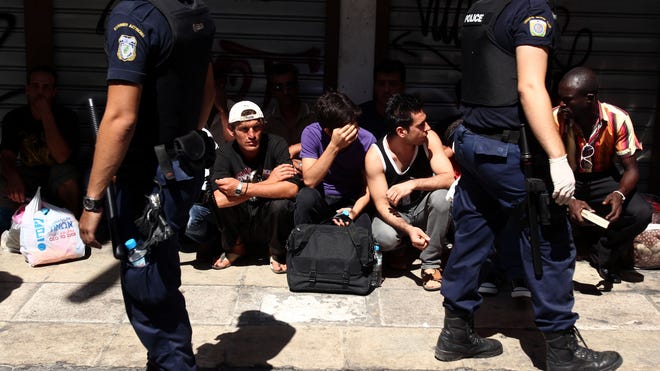
Greece is at it Again: Mass Deportation Raids Over the Weekend

Via FoxNews
Very depressing news from Greece in the last few days, as the government has rounded up thousands for deportation and shamelessly sought to shift blame for financial issues onto the shoulders of non-citizens.
The minister, Nikos Dendias, defended the mass detentions, saying that a failure to curb a relentless flow of immigrants into Greece would lead the country, which is surviving on foreign loans, to collapse. “Our social fabric is at risk of unraveling,” Mr. Dendias told a private television channel, Skai. “The immigration problem is perhaps even greater than the financial one.”(NYT)
 Oh, if only that were true.

Unfortunately, it is far more likely that this is a cynical move to distract from the country's actual financial problems- reliance on foreign debt, risky lending, artificial inflation- by suggesting that this is an outsider problem, caused by foreigners.

As we have discussed previously in this blog, Greece's asylum system is dangerously backed up, with asylum seekers waiting for years to get a (mandatory) interview or possibly receive refugee status if they are entitled to. With Greece being an entry point into the EU, and with the masses of refugees pouring out of countries effected by the recent tumult in the Middle East, this has meant a compounding of problems- larger numbers of people waiting larger amounts of time to have their status regularized (or, alternatively, to reach a determination that they are not refugees and may legally be deported.) This means some people have been living in Greece for years, waiting to get their status regularized.

It is understandable that the Greek government is anxious to clear up this issue. However, the solution is not to utterly disregard human rights obligations, both under EU and international human rights law, by arbitrarily deporting anyone found during mass "immigration raids" to not possess papers. Not only are some of these individuals likely to be waiting for their appointment with the immigration services, but more to the point, deporting an individual who qualifies as a refugee is refoulement, and is reprehensible and illegal. And you can't tell whether a person is a refugee by a brief glance at their papers, or lack thereof. When 6,000 people are detained over one weekend, it is hard to believe that anyone received a fair shake at a refugee status determination interview.

As history has often demonstrated, in times of economic and social strife it is tempting to rely on xenophobia and anti-immigrant sentiment as a tool of distraction. But that doesn't mean they should get away with it.

Come on, Greece, you can do better.

Previously:
Greece: The Pressure is on to Fix an Failing Asylum System
Deja Vu: Greek Immigration Crackdown


Tuesday, April 3, 2012

Non-Citizen News Roundup

Greece police roundup immigrants this week, via LA Times
There's a lot going on in world of non-citizens this week!

Greece: Last week I noted the alarming news out of Athens, where police arrested some 500 people during an "immigration sweep" in the Capitol that they announced would be continued regularly. Amnesty International has added their voice to the growing concern about the practice, noting:
There are no appropriate facilities at Greece's borders for the identification of those in need of international protection, such as victims of torture and unaccompanied or separated asylum-seeking children.
Detaining people arbitrarily in massive "sweeps" without the necessary protective measures for persons entitled to different forms of protection violates Greece's international obligations and contributes to stigmatization of a group that is already at risk in the country. I said it before and I'll see it again: Greece would be far better off using the resources needed for such massive police actions on clearing through their backlog of immigration cases and regularizing the status of those who are entitled to it.

USA: Despite the Obama administration's ambitious new immigration guidelines for LGBTI persons, they aren't out of the water on gay immigration issues yet. A class action suit filed Monday by 5 same-sex couples will challenge DOMA (the Defense of Marriage Act) - a 1996 law that bars the federal government from recognizing same-sex marriages. Since immigration and citizenship are the realm of the federal government, the impact is that even couples who marry legally (e.g., in NY) cannot access immigration benefits such as a green card for the foreign partner. Obviously this causes many heart-rending situations where a married couple may have to constantly fear that one spouse will be deported.

The case is being brought by a non-profit called Immigration Equality, and I will definitely be following it closely here as it proceeds through the legal system. This could be a landmark case for immigration equality in the United States and since the Obama administration has already announced that they consider DOMA to be unconstitutional it could be a slam dunk. I'm excited about this one, guys!
Immigration Equality: Taking our Case to Court

Ghana/ Liberia: There's been talk for years (at least since 2008) of Ghana activating the cessation clause and closing down refugee camps housing Liberians who fled during years of civil war. (Recall that they cessation clause of the 1951 Convention comes into effect when the situation that produced the potential for refoulement to the home country ceases to exist.) Annnnd now the talk continues, with the Ghanaian government planning to activate the cessation clause June 30th but hoping that most refugees will opt for voluntary repatriation before then. For many of the refugees who have lived in the country for years, returning to Liberia is simply not an option, and they will seek options to regularize their status before being kicked out. I'll be sure to post developments. 
Relief Net: Days numbered for Liberian Refugees

Friday, March 23, 2012

The Way to be in a PSG: Obama's new Guidelines on LGBTI Asylum

As promised, I wanted to highlight some of the guidelines offered by USCIS in their new training module on handling asylum claims of Lesbian, Gay, Bisexual, Transgendered, and Intersex persons. I've discussed LBQT (but not Intersex) asylum claims on this blog before, and one of the big themes encountered was the phenom of being"not gay enough for the USA"- individuals being turned down for asylum claims because their outward behavior did not match preconceived notions of what gay people act like. (For example, a lesbian with a child from a previous marriage, a man not "out" to his friends or family.) Let's check out how the new training addresses these and other important issues.

Defining LGBTI
Towards the beginning of the guidelines there is a set of definitions which does an excellent job of dispelling certain myths and the LGBTI community. For example, the section differentiates between sexual orientation, sex, and gender identity, and defines intersex and transgender deftly as well, being sure to not lump all categories into one.
 "Transgender is a gender identity, not a sexual orientation. Thus, like any other man or woman, a transgender person may have a heterosexual, bisexual or homosexual sexual orientation." (at 13)
Additionally, the module lumps in HIV and AIDs issues- both because persons with AIDs are sometimes persecuted for being gay (even when they are not) and persons who are gay are sometimes persecuted for having AIDs (even when they do not.) 

Havana Social Club- Does being gay put you in a "particular social group?"
As you may recall, to qualify as a refugee under the 1951 convention you must demonstrate a well-founded fear of persecution in your home country on the basis of your race, national origin, religion, membership in a particular social group, or political opinion. LGBTI asylum claims have long been handled under the "membership in a particular social group" (PSG) portion of 1951, and the case that is most relied on is Matter of Acosta. (I previously reviewed Acosta here.)

The guidelines make a point of adding to Acosta a newer precedent relevant in making immigration decisions for the LGBTI crowd: Matter of Toboso Alfonso (1990), a case involving a Cuban national claiming persecution for being gay. In Cuba, the government would force him to appear for forced exams where he was probed about his sex life, detain him on occasion, and tolerate harassment and violence against him and other gays, culminating in being chased out of Cuba by what amounted to an angry mob. In the case, TA had been convicted of several crimes making him ineligible for asylum, but the judge granted "leave from deportation" (which has similar criteria) on the basis of his past persecution in Cuba, where he was overtly targeted as a homosexual. The INS appealed, stating (rather heartlessly, even for back then),"socially deviant behavior, ie, homosexual activity is not a basis for finding a social group within the contemplation of the act." They went on to explain that such a decision would pave the way for people to be awarded protection for deviant, even illegal behavior in their home country. Are we going to start granting asylum to people that broke their country's law and don't want to go to jail?

The BIA disagreed, finding that TA was targeted not so much due to his illegal or deviant behavior, but because of his status as a homosexual, an "immutable characteristic" that he could not, and should not be required to change. Thus we have it: a game-changing BIA decision filing "gay" as a potential particular social group under the refugee convention as well as the US's own laws.

Now, this was a specific case with a man whose story left very little room for doubt that he was being persecuted on the basis of his "status" as a gay man. However, the guidelines now set out to make it crystal clear that this decision was not just about gay male Cubans. PSGs might be also be comprised of transgendered persons (gay or straight), "closeted" gays and lesbians, HIV+ persons, persons viewed by society as not fitting gender roles (eg, being an effeminate male) AND (in case you aren't getting it) people who are NOT EVEN from Cuba. (at 15.) The point is, the kind of neanderthals that want to beat up sexual minorities are not going to care if you're not actually a sexual minority. And that doesn't mean you shouldn't get protection.

So it covers people that might look or act gay (through the persecutor's eyes) but aren't. But it also effectively states that you don't have to "look or act gay"to fit into the precedents of TA or Matter of Acosta.
When analyzing the PSG issue, you must not only make a finding regarding immutability or fundamentality, you must also determine social visibility or social distinction, i.e., whether the actual or imputed characteristic is "easily recognizable and understood by others to constitute a social group." Some adjudicators mistakenly believe that social visibility or distinction requires that the applicant “look gay or act gay.”  In this context, social visibility or distinction does not mean visible to the eye. Rather, this means that the society in question distinguishes individuals who share this trait from individuals who do not. (at 16.)
 In other words, the Obama administration is promulgating as US law an important, and possibly life-saving principle: when it comes to the LGBTI community, one's membership in a PSG is all in the eyes of the persecutor.

Thursday, December 8, 2011

Landmark Stateless Conference in Geneva this Week

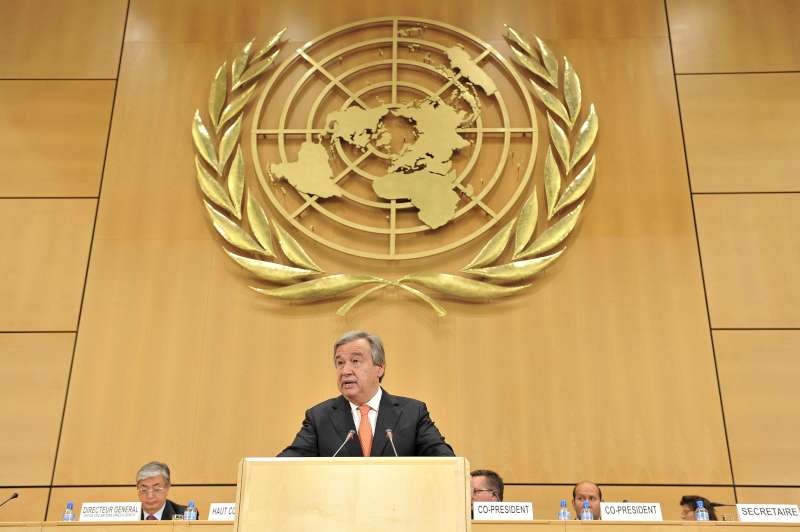
As mentioned a few weeks ago, the UNHCR is holding its major conference on forced displacement and statelessness this week in Geneva. Today is the second day of the conference, and of course we are all eagerly waiting to hear what is in store (and especially whether any states will be making announcements pertaining to Treaty signatures). However, a lot has already happened, so here is a quick recap for those of us not lucky enough to be in Geneva.
  •  High Commish Antonio Guterres opened the event with a speech emphasizing re-commitment, especially in the face of increased fear and intolerance. "Populist politicians and irresponsible elements of the media exploit feelings of fear and insecurity to scapegoat foreigners, to try to force the adoption of restrictive policies, and to actively spread racist and xenophobic sentiments," he said, in a comment that was a little more political than one is used to hearing from UNHCR. He emphasized the principles of collective security and non-refoulement that underlie the refugee regime, and announced a new effort by the organization to concentrate more heavily on gender and sex-based violence.
  • A theme of the conference was "pledges for refugees:" States were encouraged to make commitments to strengthen existing laws or create new ones designed to identity and protect stateless persons and refugees. Most of the attendees apparently pledged to help in one way or another. (See some on twitter, #pledges4refugees")
  • Sarnata Reynolds was live-tweeting the events yesterday and her tweets are definitely worth a perusal. Among the revelations: Georgia is about to pass the 1951 Statelessness Convention (YES!), Korea will adopt legislation promoting rights of asylum-seekers, Papa New Guinea will lift reservations on conventions (among other things), and Krygistan will promote child registration to reduce statelessness. If even some of the pledges are kept, the conference will have been a huge success!
  • Serbia mysteriously alluded to new changes to the citizenship laws that would "enable all persons in Serbia’s territory to acquire citizenship". I'm working on this issue right now, so I am very curious to what they are referring... Remarks available here.
  • U.S. Secretary of State Hillary Clinton gave a speech focusing on gender and statelessness, highlighting the link between discriminatory citizenship laws and children born stateless. "Because of these discriminatory laws, women often can’t register their marriages, the births of their children, or deaths in their families. So these laws perpetuate generations of stateless people, who are often unable to work legally or travel freely..."  She then went on to pledge the US's support in encouraging universal birth registration. Oh man, if loving Hillary Clinton is wrong, I don't want to be right. (Full text of speech available here.)
The conference continues today! You can follow it live via satelite here at the UNHCR's livestream.

Wednesday, November 30, 2011

South Africa: Legal Changes Hurt Asylum Seekers

It's another case of a huge backlog of asylum seekers persuading the government to make decisions that are not well thought out.

South Africa has a huge number of asylum seekers- UNHCR estimates just under 230,000- most of whom originate from Zimbabwe, supplemented by others from the Great Lakes region and the Horm of Africa. Starting in 2009, (perhaps overwhelmed by the numbers) the South African government took a generous policy towards Zimbabweans fleeing Mugabe's regime. Under a "special dispensation," refugees were entitled to remain in S.A. for 6 months, seek employment, and take advantage of educational and healthcare opportunities while their asylum applications were being processed, all without any form of documentation. (Although the dispensation was designed to assist Zimbabweans, as you might be able to guess, the "no documents" feature enabled a range of different nationalities to take advantage of the law.)

Now the government is back-tracking, concerned that economic migrants are abusing a system designed to protect "real" refugees. The department of Home Affairs has resumed deportations, and in the following weeks they will launch an inquiry to the minimum rights asylum-seekers are entitled to, and likely lift the dispensation for Zimbabweans as well as block rights to education and employment. The result could be thousands of asylum seekers in legal limbo, awaiting the outcome of their asylum application while unable to work or study. These developments, in conjunction with harsh announcements from the government and the closing of two refugee facilities, seems to signal a shift towards a harsher asylum regime in South Africa. As one government spokesman stated:
"South Africans must feel safe. If we're not able to control our illegal immigration, people won't feel safe."
It is understandable that providing education and/or employment for thousands of refugees is a costly measure. But the opposite can be ultimately be more expensive: thousands of individuals awaiting the outcome of their claim, turning to begging, crime, or black market employment to make ends meet. Which option do you think is safer for the people of South Africa? And in the event that the move forces massive returns to Zimbabwe as some fear it might, there is the question of whether S.A. is meeting its treaty obligations, particularly as pertains to non-refoulement.

In the end, the real question for South Africa is: is there a middle ground between all or nothing for Zimbabwe's asylum seekers?

Wednesday, November 9, 2011

UNHCR to host major summit on statelessness

UNHCR announced yesterday that they would hold a major summit in Geneva on December 7th and 8th on the topic of statelessness and forced displacement, calling it "the diplomatic centerpiece" of the year.

Adrian Edwards, UNHCR spokesperson, announced that major government representatives from many countries would attend, as well as at least one head of state (probably not Berlusconi, sadly) and that there would be a "treaty signing event". Given that the major treaty focus of the year is the 1961 Convention on the Reduction of Statelessness, it seems we can hope for some additional accessions. Of course, there are still plenty of countries that have not signed the Refugee Convention (coughASIAcough) so that could be another focus.

So, in one month are we going to see some major advances on statelessness and displacement? Let's hope so! Wish I could snag an invite....

UNHCR to host international meeting on world's stateless, forcibly displaced

Thursday, October 14, 2010

LGBTQ Asylum II:Case Law- USA

The last post discussed the 1951 Convention and its "membership in a particular social group" clause, concluding that this is most likely the best fit for LGBQT asylum claims, and was perhaps even contemplated as such by Convention drafters. In this installment, we'll review some important case law where states used the clause to grant protection to applicants.

In Acosta, a 36 year old Salvadorian man requested leave to remain in the USA during a deportation hearing, applying for asylum. The Judge denied in the first instance, stating that he had failed to meet the burden of proof for his claim, and he appealed to the BIA (Board of Immigration Appeals.) His argument rested on the fact that he was a member of a group of Taxi drivers that was being harassed by anti-government guerillas, whom eventually directly threatened his life. The Court had to address: does this count as a "social group"?

The BIA held that members of particular social group usually share a “common, immutable characteristic” or sometimes a “shared past experience.” More to the point, the Court held that the common characteristic “must be one that the members of the groups either cannot change or should not be required to change because it is fundamental to their individual identities or consciences.” (emphasis mine)

Although not meant to address LGBQT concerns, this definition (the "immutable" principle) is useful because it accommodates much of the debate surrounding sexual orientation. Although it is increasingly believed that sexual orientation is an innate characteristic that cannot be altered by, for example, religious conversion or therapy, it is all the same problematic to sweep out individuals who may feel that their sexual behavior is a choice, but one that is an essential part of their identity. This definition helpfully leaves the debate out of the question by including characteristics that, regardless of their immutability, should not be forcibly eradicated.

Unfortunately, it also leaves the door open for Judges to opine that sexuality is something that both can and should be changed by the applicant. And in the US, this opinion is unfortunately not so uncommon.

Not Gay Enough for the USA
Another big problem with the US asylum scheme for LGBQR applicants is covered in Deborah Morgan’s article "Not Gay Enough for the Government: Racial and Sexual Stereotypes in Sexual Orientation Asylum Cases" (2006) . Morgan focuses on a United States asylum case that pointed out some of the flaws of the immigration system when dealing with an applicant that did not fit into preconceived sexual orientation notions.

 In the Mohammed case, the asylum seeker was a gay Iranian man seeking asylum in the United States after many years of sexual abuse, discovery by the Iranian government (who sometimes punishes homosexuality with death) and further abuse and disownment by his family.  He filed an asylum claim in the United States, and went through the standard interviews and procedures that accompany the asylum process there. However, “Mohammed” had a problem: he did not have sufficient evidence of his sexual orientation. He did not appear “feminine, ” was not openly “out” in the United States where he lived with his Iranian-American partner, and did not have evidence of any of his participation in activities that would have confirmed his identity, such as “participation in gay pride parades.”  (Yes, seriously.) The immigration judge concluded that, “Mohammed was able to hide his sexual orientation well enough to pass as a heterosexual, therefore upon returning to the Iran he could do the same and not have any further problems.”  Unfortunately, this case is just one of many where asylum was denied because of person’s perceived ability to pass or non-demonstration of gay stereotypes.

Not only is this standard absurdly unfair, it also goes far beyond what is required by the 1951 Convention. The Convention requires a nexus between an individual’s membership in a particular social group and his reasonable fear of persecution. Why should it be necessary, then, to match the certain characteristics that this social group might have in the receiving country? An analogous situation would be the Court requiring a person fleeing persecution based on their religious identity to demonstrate that they live out their religion in the receiving country in the same way as other members of that religion do in that country. This additional hardship is likely to cause problems for people coming from non-Western countries, where the LGBT lifestyle is lived very differently.

In sum, the US has some excellent and broadly useful case law on social group membership that can be very beneficial for LGBQT asylum claimants. On the other hand, the perceptions and stereotypes of individual Judges reflect the same ones of the rest of the society, and can unfortunately present a significant obstacle for individuals from non-Western countries.


For more on Acosta, see: Susan B. Goldberg. Give Me Liberty or Give Me Death: Political Asylum and the Global Persecution of Lesbians and Gay Men. 26 Cornell Int’L L. J. 605, 613-615. (1993).
For more on LGBQT Asylum claims in the USA, see: The Difficulties of US Asylum Claims based on Sexual Orientation, Swetha Sridharan, via MPI.

Thursday, September 30, 2010

Does the Refugee Convention Provide rights for non-Refugees?

The most elementary right owed to refugees is that they not be returned, or “re-fouled” to their home state where they are endangered. The classic expression of the principle is found in the 1951 Convention: “No contracting state shall expel or return (“refouler”) a refugee in any manner whatsoever to the frontier of territories where his life or freedom would be threatened on account of his race, religion, nationality, membership in a certain social group or political opinion.”[1] The principle of non-refoulement is becoming, if it is not already, considered a “peremptory norm” of international law that binds all states. [2]     

In earlier treaties and in the original drafts of the 1951 Convention, the duty of non-refoulement applied only to individuals lawfully present in the state, “refugees who have been authorized to reside in [state party] regularly.”[3] But a shift occurred during the drafting, probably related to the fact that so many refugees were already present in the member states, that a restriction requiring legal entry would have the effect of delegitimizing the majority of valid refugees already present. It seems that parties had already acknowledged this fact, since the discussion of clandestine entry in the travaux is limited to stating that that it is acceptable.[4] Simply put, under the under the principle of non-refoulement any removal at all that puts the refugee in danger is prohibited, whether classified as deportation, forced repatriation, or any other name.[5] This applies to individuals regardless of whether they have been recognized as refugees by the state apparatus.[6] In other words, the principle of non-refoulement attaches at the same moment that you become a refugee under the 1951 Convention, and neither the status determination nor the attaching obligation is dependant on state classifications. This fact is important for undocumented migrants for two reasons

First, it legitimizes illegal entry in certain cases. As a matter of fact, the duty of non-refoulement only applies to individuals already present in the receiving state. As Hathaway explains, “if the duty of non-refoulement under Art. 33 of the Refugee Convention can be claimed only by persons who are, in fact, refugees, then it is not a right that inheres in persons who have yet to leave their country… because Art. 1 of the Convention defines a refugee as a person who resides‘outside the country of his nationality.’”[7] Opening the door to illegal entry is an important feature in and of itself, as it demonstrates that there are occasions in international law when the territorial jurisdiction of a state cedes precedence to the needs to an individual.
 
The second importance of non-refoulement as it relates to clandestine entry is that it creates a presumption that individuals entering a country illegally could potentially have a claim to asylum. This presumption in turn creates a need for a minimum standard of administrative procedures prior to expulsion that could be beneficiary for a person regardless of his or her status.

Status Determinations
If an individual meets the definition of refugee under the 1951 Convention then he or she is a refugee, regardless of whether or not his or her host government or any other body finds otherwise. The 1967 Protocol does not list formal status recognition as a requirement[8] and the Handbook on Procedures and Criteria for Determining Refugee Status (“the Handbook”) explicitly states that a person becomes a refugee at the instant he or she fulfills the criteria. “Recognition of his refugee status does not therefore make him a refugee but declares him to be one. He does not become a refugee because of recognition, but is recognized because he is a refugee.”[9] This being the case, states may not expel individuals without some basic form of procedural due process to determine the validity of their asylum claim, lest they violate the principle of non-refoulement.

UNHCR recognizes that a variety of procedural systems could adequately determine refugee status, and therefore does not suggest one method for doing so, but does lay out a set ofrecommendations for minimum standards when dealing with refugee status determinations that would comply with the Convention.[10] At the least, individuals should have an opportunity to speak to an official familiar with the State’s international obligations, have access to an interpreter, and the ability to remain in the country pending adjudication of his application, as well as the opportunity to appeal at a higher court.[11]

While it would seem that a majority of 1951 convention states do comply with UNHCR’s recommendation in some form, the effect of these basic due process provisions is beneficial to undocumented migrants regardless of whether or not they are enacted. First, they provide an opportunity to engage with the receiving state’s legal system that may lead to residence status, even in the absence of a refugee determination under the 1951 Convention. Second, in States that do not comply, the lack of these standards is a foothold for NGO’s and human rights treaties to attack the treatment of migrants in general.

*Excerpted from a previous memo on the subject of non-refoulement and rights for undocumented peoples.

________________________________

[1] 1951 Convention at art. 33
[2] Daniel Bethlehem and Sir Elihu Lauterpacht "The Scope and Content of the Principle of non-refoulement: Opinion", in Refugee Protection in International Law 107 (Erika Feller, Volker Turk, Frances Nicholson eds., 2001)
[3] Convention Relating to the Status of Refugees, 159 LNTS 3663, Oct. 28, 1933 at Art. 3.
[4] Collected Travaux at A/CONF.2/SR. 5, 16 
[5] Bethlehem and Lauterpacht supra note 126 at 112.
[6] Id at 116
[7] James C. Hathaway. The Rights of Refugees under International Law. 307 (2005)
[8] 1967 Protocol
[9] UNHCR, Handbook on Procedures and Criteria for Determining Refugee Status under the 1951 Convention and the 1967 Protocol Relating to the Status of Refugees ¶ 28, UN Doc.  HCR/IP/4/ENG/REV.1.
[10] Id at 191
[11] Id at 192 (i)-(vii)

Wednesday, September 15, 2010

LGBQT Asylum Part 1- a good fit under "particular social group?"


As states like Uganda pass restrictive measures against gays and lesbians, and countries all over the world continue to harass people that dare to be openly transgendered or gay, it is worth asking whether the 1951 Refugee Convention accommodates LGBQT asylum claims. My opinion? It should, easily, but the practices of receiving states vary, and often reflect their ambivalence with their own LGBQT populations.

"Particular Social Group"
The most vague group protected under 1951 Convention’s refugee definition is “member of a particular social group.” In recent years it has been invoked as a basis of asylum by a range of people both successfully and unsuccessfully, including but not limited to, victims of Female Genital Mutilation (See: Mohammed v. Gonzales, 400 F.3d 785 (9th Cir. 2005)), ex-gang members (see: INS v. Elias-Zacarias, 502 U.S. 478 (1992)), the disabled , and a range of LGBT individuals. But what exactly does this phrase mean?

The Refugee Convention Handbook states, “a ‘particular social group’ normally comprises persons of similar background, habits or social status. A claim to fear of persecution under this heading may frequently overlap with a claim to fear of persecution on other grounds, i.e. race, religion or nationality (77)." As this definition indicates, the “social group” category is rather broad. The travaux preparatoires is scarcely more helpful. “In the first place, experience had shown that certain refugees had been persecuted because they belonged to particular social groups.  The draft Convention made no provision for such cases, and one designed to cover them should accordingly be included (14)” With so little elaboration, it is difficult to determine what exactly was contemplated at the time of the group’s inclusion within the 1951 Convention.

However, it's at least possible, if not probable, that persecution for reason of sexual orientation could have been in the mind of the authors of the convention. The other categories tend to roughly correspond to the groups of people that were persecuted under German and Italian fascism, and which had caused large numbers of refugees during the post-World War II period. It could scarcely have escaped the attention of the drafters that alongside Jews, Gypsies, Anarchists and anti-fascist Resistance members, gays and lesbians were also targeted heavily by the Nazis.

Additionally, UNHCR has clarified its position on several occasions, most notably in a 2004 Advisory Opinion to the Tokyo Bar Association. In the Opinion, UNHCR explains that sexual orientation can be a cognizable “social group” under the 1951 Convention. “…In UNHCR’s view, homosexuals can be within the ambit of a social group category, either as a group sharing a common characteristic or because they are perceived as a cognizable group in the society (8)". In addition, the Opinion notes that while not all LGBT individuals are automatically entitled to refugee protection, that persecution can be proved in a variety of ways, including by reference to laws criminalizing homosexuality(4).  


So, it would seem that "membership in a particular social group" is in fact a good fit for many LBQT asylum claims. Stay tuned for part two, when I'll review some relevant case law on the subject.